S-3 2nd floor Malik plaza plot No -5 sector 4 Dwarka New Delhi 110078
Find Property by City Location
1City
2Category
3Type
4Developer
Select City Location
Choose Category
Property Type
Choose Developer
Blogs
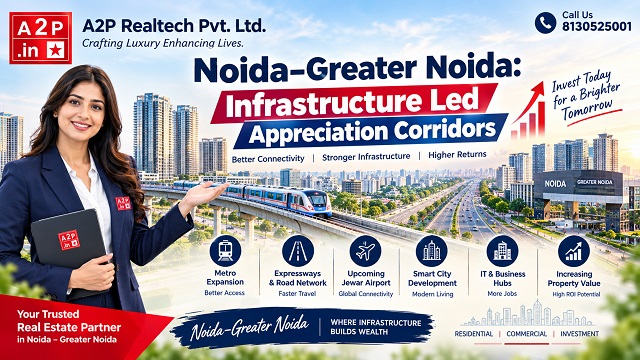
Noida–Greater Noida: Infrastructure Led Appreciation Corridors
Social Media Share
Noida–Greater Noida: Infrastructure-Led Appreciation Corridors
Noida and Greater Noida are entering a new phase of real estate development. The story is no longer limited to new housing projects or comparatively large land parcels. A wider infrastructure ecosystem is now shaping the region: Noida International Airport at Jewar is operational, the Noida–Greater Noida transport network is expanding, new road links are being planned, the Yamuna Expressway region is attracting industrial and logistics activity, and large-scale developments are creating new employment and consumption catchments.
A2P Realtech's published approach is built around requirement-based property selection, project comparison, investment consultation, site visits and end-to-end transaction support. Its website and recent content also show active coverage of Noida and Greater Noida opportunities alongside its established Gurgaon/NCR focus.
Why Infrastructure Has Become a Major Real Estate Driver
Real estate demand is closely connected to accessibility. A home becomes more useful when commuting becomes easier. A retail destination becomes more viable when customers can reach it conveniently. An office market expands when employees and businesses can access it from multiple directions. Industrial and logistics assets become more relevant when highways, airports and freight routes improve.
Noida and Greater Noida are notable because several infrastructure layers are developing around the same broad geography: the Noida–Greater Noida Expressway, Yamuna Expressway, Noida International Airport, Aqua Line metro expansion, new road connections, industrial clusters and planned development in the Yamuna Expressway region.
The result is not one uniform market. It is a collection of connected corridors at different stages of maturity. Established Noida sectors already have urban infrastructure and employment. Southern Noida has a strong expressway and residential ecosystem. Greater Noida West is expanding its residential catchment. The Yamuna Expressway corridor is increasingly connected to the airport and industrial development. These differences matter when evaluating a property.
Noida International Airport:
One of the most important changes is the transition of Noida International Airport from a long-term infrastructure project into an operating airport. Commercial flight operations began on 15 June 2026, with IndiGo operating the first scheduled commercial service. The airport initially focuses on domestic operations, with international operations planned to follow.
This changes the nature of the property discussion. Earlier, many investment narratives around Jewar and the Yamuna Expressway were based on expectations. With commercial aviation now operational, the region can increasingly be assessed through actual connectivity, passenger movement, airline activity and the development of the surrounding economic ecosystem.
The airport is also part of a larger regional plan. YEIDA identifies airport infrastructure alongside industrial projects, logistics development, the proposed International Film City, sports facilities and other connectivity assets. For real estate, the strongest impact should come where airport access is combined with employment, hospitality, logistics, commercial or residential demand.
Being 'near the airport' alone is not an investment thesis. The relevant question is what economic activity the airport enables around the property.
1: Noida–Greater Noida Expressway
The Noida–Greater Noida Expressway is one of the region's most established infrastructure-led corridors. It connects major Noida employment and commercial districts with Greater Noida and supports a large residential ecosystem.
The southern stretch around Sectors 148, 150 and 151 has attracted particular attention because of large residential developments, open spaces, institutions, expressway access and metro connectivity. Sector 148 is associated with the Aqua Line network, strengthening the public-transport layer.
This corridor demonstrates how infrastructure can reinforce itself: road connectivity supports commuting, metro improves public transport, residential communities create population, and commercial and institutional activity provides employment and services.
2: Sector 150–152 and Southern Noida
Southern Noida has developed a distinct identity around larger residential developments, sports and open-space planning, the expressway and improving connectivity. Sector 150 in particular has attracted premium housing and lifestyle-oriented projects.
The investment logic is therefore not simply 'premium housing equals appreciation'. A better framework combines accessibility, land planning, residential quality, regulatory clarity, surrounding development and future demand.
3: Greater Noida West
Greater Noida West has become one of the region's major residential expansion zones, supported by new communities and improving links toward Noida, Greater Noida and Ghaziabad.
The key issue is connectivity. Rapid residential growth can create traffic pressure if roads and public transport do not keep pace. Authorities have been working on road improvements and larger regional links.
A proposed elevated road connection toward NH-9 has been discussed to improve regional movement. Such projects should be treated as development factors rather than guaranteed benefits until their execution stage and timelines are confirmed.
At the project level, buyers should examine internal infrastructure, public transport, schools, retail, road access and actual occupancy instead of relying on future-growth claims.
4: Yamuna Expressway and the Jewar Airport Belt
The Yamuna Expressway corridor is perhaps the clearest example of an infrastructure-led transformation in the wider region. YEIDA's notified area extends along the 165-km Yamuna Expressway, with Noida International Airport, industrial clusters, logistics infrastructure and the proposed Film City forming part of the broader development framework.
The airport is the anchor, but the long-term economic potential depends on what develops around it. Manufacturing, warehousing, logistics, hospitality, aviation-related services, commercial activity and residential communities can create a broader employment base.
For investors, the opportunity and risk are closely linked. Large infrastructure can unlock land and demand, but development takes time. Distinguish between operational infrastructure, funded projects, approved projects and concepts still at the planning stage.
5: Film City and the Emerging Media-Economy Cluster
The proposed International Film City at YEIDA Sector 21 adds another economic layer to the airport corridor. YEIDA describes an approximately 1,000-acre integrated media infrastructure development located around 4 km from Noida International Airport.
The proposed ecosystem includes studios, editing and VFX facilities, special-effects infrastructure, film-festival facilities, commercial areas and other parts of a media-production value chain.
Investors should not price property solely on a future Film City announcement. The project is relevant because it illustrates how an employment and economic cluster can generate secondary demand for housing, retail, hospitality, services and commercial space.
As this ecosystem develops, the useful real estate question will be which surrounding locations offer practical access to jobs, transport and daily services.
Corridor 6: Noida's Aqua Line Expansion
Metro connectivity is one of the most important factors in making a real estate corridor usable without relying entirely on private vehicles. NMRC has moved forward with Aqua Line expansion projects.
The significance is larger than the number of stations. Botanical Garden is an important connectivity point for Noida, while Sector 142 is an established office cluster. Better connections between Noida and emerging Greater Noida can gradually expand the effective residential and employment catchment.
Metro proximity should be measured by practical access, not simply the distance shown in a brochure.
7: New Regional Road Connections
The next stage of infrastructure development is increasingly about linking existing corridors. Greater Noida's budget included a proposal for a 37-km road extension toward the Hapur bypass with a further connection toward the Ganga Expressway. Separate plans have also been reported for a larger elevated connection between Noida Sector 94 and Greater Noida's Chi-V area to manage future airport-related traffic.
Projects at this scale can influence land-use patterns over time, but proposed infrastructure should not be valued as if it were already operational. Approval, funding, tendering, construction and commissioning are different stages.
Why Infrastructure Does Not Automatically Mean Appreciation
· A new expressway can improve access, but the property still needs a viable surrounding catchment.
· A metro station can improve mobility, but the project must be genuinely accessible from that station.
· An airport can attract economic activity, but benefits vary significantly by micro-market.
· An industrial cluster can create jobs, but residential demand may take time to mature.
· A future road can become valuable, but delays can change the investment timeline.
How to Read an Infrastructure-Led Real Estate Corridor
1. Identify the infrastructure asset: airport, metro, expressway, industrial cluster or major road.
2. Check its status: operational, under construction, approved, tendered or proposed.
3. Map the actual distance and access route from the property.
4. Study current population and occupancy around the project.
5. Identify nearby employment centres and commercial demand.
6. Review schools, hospitals, retail and daily-use infrastructure.
7. Check competing projects and future supply.
8. Examine developer execution and project documentation.
9. Calculate the total acquisition cost instead of comparing only headline prices.
10. Define the holding period and possible exit market.
Noida vs Greater Noida: Why the Micro-Market Matters
|
Market / Corridor |
Primary Driver |
What Buyers Should Examine |
|
Established Noida |
Mature roads, metro and business districts |
Pricing, rental demand, supply and urban maturity |
|
Noida–Greater Noida Expressway |
Expressway + Aqua Line + employment hubs |
Metro access, occupancy, social infrastructure and project quality |
|
Sector 150–152 |
Expressway + metro + planned urban environment |
Regulatory status, delivery, surrounding development and supply |
|
Greater Noida West |
Residential expansion + road/metro improvements |
Connectivity, congestion, occupancy, schools and retail |
|
Yamuna Expressway / Jewar |
Airport + expressway + industrial/logistics ecosystem |
Development stage, employment creation and airport access |
|
Film City / Sector 21 |
Airport + proposed media ecosystem |
Actual project progress and future employment catchment |
What Current Market Data Tells Us
Knight Frank's NCR research identifies established Noida business districts and the Noida–Greater Noida Expressway as important office micro-markets. Across India, Colliers reported 71.5 million sq. ft. of Grade A office leasing in the top seven cities during 2025, while JLL reported 83.3 million sq. ft. of gross leasing. The wider office-market strength matters because employment is one of the foundations of residential and commercial demand.
Why Employment May Matter as Much as Infrastructure
Infrastructure can bring people closer, but employment gives them a reason to stay. Noida already has established office and business districts, while Greater Noida and the Yamuna Expressway region are attracting industrial, logistics, manufacturing and technology-related activity.
Invest UP highlights an upcoming 206-acre electronics manufacturing cluster in YEIDA Sector 10 near Noida International Airport and an Integrated Industrial Township at Greater Noida. Its investment framework also identifies the New Noida industrial-development initiative.
This is why infrastructure-led appreciation should be viewed as an ecosystem rather than a single project. Airport + industrial cluster + road + metro + residential supply can create a stronger demand loop than any one component alone.
How A2P Realtech Can Help Buyers Evaluate These Corridors
A2P Realtech's website positions the company around personalised property selection, project comparison, investment consultation and end-to-end assistance. Its published portfolio includes residential and commercial opportunities, and its recent content includes Noida and Greater Noida projects such as Sector 128 Noida, Sector 142 Noida and Sigma 3 Greater Noida.
This approach is relevant to infrastructure-led markets because buyers need comparison, not just a single project pitch. A2P Realtech can structure the search around the buyer's objective—end use, rental income, long-term investment, commercial use or portfolio diversification—and then compare relevant locations and projects.
· Requirement-based property shortlisting
· Project and micro-market comparison
· Site-visit coordination
· Location and connectivity discussion
· Investment-oriented property consultation
· Booking and transaction coordination
· Documentation coordination and post-sales assistance
A2P Realtech's role should complement, not replace, independent legal, financial and regulatory due diligence. Buyers should verify project approvals, RERA information where applicable, title and transaction documents before committing capital.
What Buyers Should Check Before Investing
· Is the infrastructure operational or still proposed?
· What is the exact distance and access route from the property?
· Is the surrounding area occupied or largely undeveloped?
· What employment centres are within practical commuting distance?
· What social infrastructure is already operational?
· How much competing residential or commercial supply is planned?
· Is the developer's delivery track record suitable for the project?
· What are the maintenance and recurring costs?
· What is the realistic rental market if income is part of the objective?
· Who is likely to buy the property from you at exit?
Common Mistakes in Infrastructure-Led Property Investment
· Buying only because a project is advertised as 'near the airport'.
· Treating proposed infrastructure as if it were already operational.
· Assuming the entire Noida–Greater Noida region will perform uniformly.
· Ignoring existing traffic and access conditions.
· Looking only at launch price without comparing the total cost.
· Assuming a projected ROI without testing rental and resale assumptions.
· Ignoring project-level legal or regulatory issues because the corridor looks attractive.
· Buying far from employment and social infrastructure on the assumption that future development will solve everything.
· Focusing only on appreciation and ignoring holding costs.
A Long-Term View: From Property Location to Economic Corridor
The biggest change across Noida and Greater Noida is the transition from isolated development to interconnected economic corridors. The airport connects the region to aviation networks. Expressways connect it to Delhi, western Uttar Pradesh and wider NCR. Metro expansion can improve intra-region mobility. Industrial and logistics projects can create employment. Film City and other economic clusters can add specialised activity.
When these components mature together, the real estate market can move from speculative infrastructure pricing toward a more established demand-based market. That transition takes time, and the benefits will not be distributed evenly.
For buyers, the most useful skill is not predicting a single future price. It is identifying locations with the infrastructure, employment, population and urban services required to support real demand.
Frequently Asked Questions
What does infrastructure-led appreciation mean?
It refers to changes in property demand or values that may be influenced by airports, metro lines, expressways, industrial corridors and other connectivity improvements. Infrastructure alone does not guarantee appreciation.
Is Noida International Airport operational?
Yes. Commercial flight operations began on 15 June 2026, initially with domestic services.
Which corridors are important to study?
Relevant corridors include the Noida–Greater Noida Expressway, Southern Noida including Sectors 150–152, Greater Noida West, Yamuna Expressway/Jewar, the Film City belt and areas influenced by Aqua Line expansion.
Is the Yamuna Expressway corridor only residential?
No. The broader YEIDA region includes airport infrastructure, industrial and electronics clusters, logistics development, Film City and other planned economic activities.
Does being near an airport automatically increase property value?
No. Airport proximity is one factor. Accessibility, employment, noise considerations, commercial development, social infrastructure and the specific property also matter.
Should buyers invest before infrastructure is completed?
It depends on risk tolerance and holding period. Buyers should distinguish between operational, under-construction, approved and proposed infrastructure.
How can A2P Realtech help?
A2P Realtech publishes services covering requirement-based property selection, project comparison, investment consultation, site visits and transaction support, along with project-specific Noida and Greater Noida content.
Follow the Infrastructure, Then Verify the Demand
Noida and Greater Noida are becoming one of the most closely watched infrastructure-led real estate regions in NCR. The operational Noida International Airport, established expressway network, expanding metro connectivity, planned road links, industrial clusters and the wider YEIDA development framework are changing the geography of opportunity.
The better question is: what economic activity is the infrastructure enabling, how quickly is that activity becoming real, and does the specific property sit inside the resulting demand catchment?
A2P Realtech can support that process by helping buyers explore residential and commercial opportunities across NCR, compare projects and coordinate the on-ground property journey. The objective is to help buyers understand the location, the project and the factors that may shape its long-term market relevance.
About A2P Realtech
A2P Realtech Private Limited is a real estate consultancy and authorised sales channel partner serving buyers and investors across Gurgaon and the wider NCR market. Its website highlights residential and commercial real estate expertise, personalised recommendations, project comparison, site visits, documentation and transaction assistance. The company also publishes project and market-focused content covering Noida, Greater Noida and other NCR growth corridors.
For buyers evaluating infrastructure-led markets, A2P Realtech can help organise the property search around budget, property type, investment objective, location preference and expected holding period.